
The business council aims to give impetus to trade.

'I want to assure this House that in these talks we have not conceded anything.' Full text of what Defence Minister Rajnath Singh told Parliament on the Chinese pullback in eastern Ladakh.

'Pleasure to meet FM Sergey Lavrov, this time in person. Excellent talks that reflect our Special and Privileged Strategic Partnership. Value our exchanges on the international situation,' Jaishankar tweeted after talks with his Russian counterpart on the sidelines of the SCO meeting.

China on Monday said Indian Prime Minister Manmohan Singh's three-day visit from Tuesday is of great importance for deepening strategic partnership amid expectations that the two sides would sign some key pacts, including one to prevent incursions along the LAC.

The issue "will not affect" the "long-standing" economic and cultural ties between the two countries, a top Chinese official said.

India has told China that disengagement at all friction points is necessary to contemplate de-escalation of troops in eastern Ladakh even as the foreign ministers of the two countries agreed to establish a hotline for "timely" communication and exchange of views.

'India-China economic ties are likely to take a hit in the wake of the new situation, but that also provides India with a new opportunity to strengthen its manufacturing base,' points out Dr Rajaram Panda.

'Open conflict would be a disaster for both China and India.'

The first-quarter foreign trade growth between China and the other four nations of BRICS (Brazil, Russia, India, China and South Africa), was 16.3 percentage points higher than China's average foreign trade growth during the period, China's General Administration of Customs said.

External Affairs Minister Sushma Swaraj on Monday met her Russian counterpart Sergey Lavrov in Moscow and raised several issues.

As the pandemic unfolded, the India-China relationship has come under severe stress. To restore normalcy, agreements between the two countries must be respected scrupulously in their entirety. Where the Line of Actual Control is concerned, any attempt to unilaterally change the status quo is unacceptable, declares External Affairs Minister Dr Subrahmanyam Jaishankar.
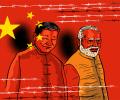
'An opportunity is at hand to think big and recast the India-China relationship on a new template, which would help the pursuit of our country's dream of major power status,' says Ambassador M K Bhadrakumar.

Gandhi has attacked the prime minister and the government over the India-China border conflict in Ladakh in the past as well and alleged their "failure" in handling the issue.

He also said it was important that even during the difficult moments of this "crisis" India has been communicating and engaging with China.

The Indian and Chinese armies have been locked in a bitter standoff at multiple locations in eastern Ladakh for over eight weeks since May 5.

'China's excessive military aid to Pakistan is the real elephant in the room as far as Sino-Indian relations are concerned. India should be confident enough to accept a degree of closeness between China and Pakistan, since China may wish to use this link for its foray into the Muslim world.' 'But the Chinese must be realistic enough to know that as time passes, the tactic of using Pakistan as a proxy to check India will yield diminishing returns. The US tried it for 60 years but failed, so will China,' says Colonel Anil A Athale (retd).

'They will try more rounds of military level talks and move it to the diplomatic and political domain to see if there is a possibility of a solution -- and like the CDS said if that does not happen, we are prepared.'
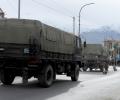
China is in no hurry to disengage at the border and the region and international community is moving on. The spectre of a long haul in Ladakh haunts India, points out Ambassador M K Bhadrakumar.
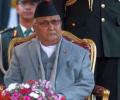
He claimed that India built a Kali temple, created 'an artificial Kali river' and 'encroached the Nepalese territory through deploying the Army' at Kalapani. The river defines the border between the two countries.
Around 1 out of every 5 people who gets COVID-19 becomes seriously ill and develops breathing difficulty, according to the World Health Organisation.
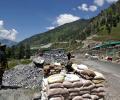
India's top military and strategic brass on Tuesday reviewed the overall situation in eastern Ladakh amid indications that the latest round of talks between senior military commanders of Indian and Chinese armies on the next phase of disengagement of troops may not have produced encouraging results, people familiar with the developments said.

External affairs ministry spokesperson Raveesh Kumar said India does not comment on the internal affairs of other countries and similarly expects other countries to do likewise.

'Modi's recent decisions to improve India-China relations, adjust India's neighbourhood policies and to rebalance India's ties with the major powers are linked to his political agenda.' 'Of course, the good part is that this agenda is also in the national interest,' says Ambassador M K Bhadrakumar.

Jaishankar is the first foreign secretary to head the Ministry of External Affairs as minister.
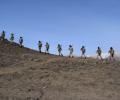
The MEA said it was the Chinese side that recently undertakook activities hindering India's normal patrols in the areas.
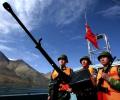
Both the Indian and Chinese armies have brought in more troops in sensitive locations like Demchok, Daulat Beg Oldie and areas around Galwan river as well as Pangong Tso lake in Ladakh, the sources said. The area around Galwan has been a point of friction between the two sides for over six decades.

Considering Modi's style of practicing diplomacy, it is likely that a clear message would be conveyed to China that it is high time Beijing stops using its good relations with Pakistan as a pressure tactic against India. This is imperative not only for strengthening India-China relations at the bilateral level but also for maintaining stability at the regional level, says Sana Hashmi.
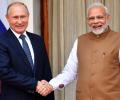
'Washington senses that the anchor sheet of India's strategic autonomy lies in its longstanding partnership with Russia, which remains firm and immutable despite the changes in world politics in the post-Cold War era,' notes Ambassador M K Bhadrakumar.<
Another round of diplomatic talks under the framework of the Working Mechanism for Consultation and Coordination is expected to be scheduled soon.

Modi's arrival has changed the optics of the visit. There is a different demonstration of the confidence level in the Indian leadership, but not much has changed beyond that, reports Sheela Bhatt/Rediff.com.
Instead of "the dragon and the elephant compete with each other", "the dragon and the elephant dance together, Chinese Foreign Minister Wang Yi said.

'Chinese troops are not geared to fight Indian troops who are battle hardened and acclimatised and are far more hardy.'

An MoU on sharing hydrological information of the Brahmaputra River by China to India and another pact on amendment of the protocol on phytosanitary requirements for exporting rice from India to China to include non-Basmati rice were signed after the Modi-Xi talks in the eastern Chinese port city.
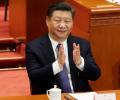
Xi ordered the military to think about worst-case scenarios, scale up training and battle preparedness, promptly and effectively deal with all sorts of complex situations and resolutely safeguard national sovereignty, security and development interests, state-run Xinhua news agency reported, without mentioning any specific issues that posed a threat to the country.

India-Maldives ties came under strain under Yameen who was perceived to be close to China.

On Day 2 of the summit, Modi and Xi held a fresh round of one-on-one discussion at the Taj Fisherman's Cove Hotel.
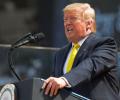
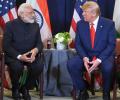
The US president previously offered to mediate between India and Pakistan, a proposal rejected by New Delhi which maintains that there is no role for any third party in bilateral issues.

'India stands to gain immensely by forging a developmental partnership with China.' 'While through sustained strategic communication there is scope to steadily expand the commonality of interests between the two countries.' 'This is also a practical way to ensure that differences do not get over-magnified and become disputes,' says Ambassador M K Bhadrakumar.

'One must remember that a dragon has a forked tongue,' warns Vivek Gumaste.
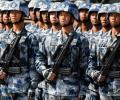
Asked about the continued tensions along the border and whether the PLA troops action was anyway related to the disagreements with the Indian government's plan to lure business out of China, Chinese Foreign Ministry spokesman Zhao Lijian said both the countries were in diplomatic contact over the face-off between their troops.
 © 2026 Rediff.com - Investor Information - Advertise with us - Disclaimer - Privacy Policy - Sitemap - Feedback - About us - Terms of use - Grievances